


Generative & Agentic AI

#industry #finance #lifesciences #other

AI Consulting for Businesses

HMS helps companies assess GenAI and agentic AI initiatives from both a business and technical perspective and turn them into production-ready solutions. We take architecture, interfaces, security, governance, and operational requirements into account from the very beginning.

Schedule an AI consultation now

Production-Ready AI Requires More Than a Model

A first prototype can be built quickly. What happens next is what really matters.

Many companies are testing large language models, copilots, and AI agents. The real work begins once the initial demo has proven successful: data quality, permissions, interfaces, user guidance, evaluation, costs, and operations must all align.

HMS helps companies evaluate GenAI and agentic AI solutions from a business perspective and implement them in production environments. To do this, we bring together expertise in AI engineering, software engineering, data engineering, and architecture within a single project team.
450+

Data & AI projects completed

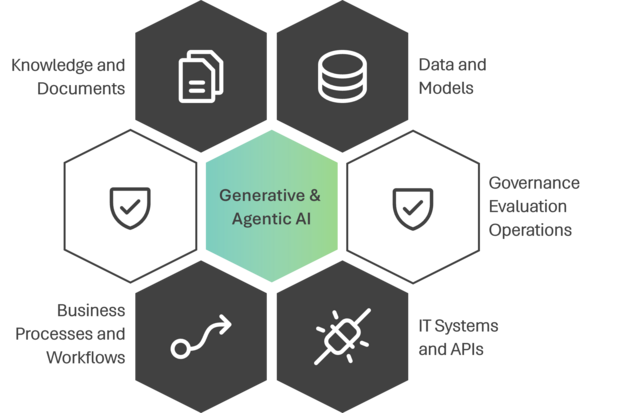
GenAI and Agentic AI Solutions Require a Common Foundation

  • relevant business knowledge
  • appropriate data and models
  • clearly defined business processes, as well as 
  • controlled interfaces to existing IT systems. 

Only by combining these elements can AI applications deliver practical business value while remaining traceable in production.

Technology Selection

The Use Case Determines the AI Approach

AI consulting begins with the question of which approach best meets the business, technical, and economic requirements. Generative AI is suitable for some tasks, while others are better suited to traditional machine learning models or rule-based software.

Data Science & Machine Learning

For forecasting, scoring, classification, and anomaly detection based on existing data.

Learn more about Data Science & Machine Learning

Generative AI

For knowledge access, document processing, content creation, and dialogue-oriented applications.

Assess a GenAI use case

Agentic AI

For multi-step processes in which AI systems retrieve information, use tools, and coordinate tasks.

These approaches can be combined depending on the specific use case. HMS evaluates the task, the available data, and traceability requirements, and uses this information to determine the system architecture.

Requirements

What Companies Need to Put AI into Production

GenAI and agentic AI solutions require a shared functional and technical foundation. Six key areas are essential for taking an AI project beyond the prototype stage.

Use Cases with Clear Business Value

The problem, user groups, and success criteria must be specific enough to allow for an assessment of the benefits and feasibility.

Access to Enterprise Data

Structured and unstructured data must be discoverable, accessible, and usable in accordance with role- and permission-based policies.

Integration with Business Applications and Existing Systems

AI solutions must be able to connect to existing platforms, APIs, and business systems.

Evaluation, Monitoring, and Cost Control

Quality, response times, model output, and operating costs require measurable criteria and ongoing monitoring.

AI Governance and Human Oversight

Roles, approvals, security, and escalation procedures define which tasks an AI system is permitted to perform.

Extensible AI System Architectures

AI systems must be designed so that they can be extended to accommodate additional requirements, users, data sources, and business domains.

At HMS, AI consulting and implementation go hand in hand.

Architecture, AI engineering, software engineering, and data engineering are all intertwined in the implementation process. We make technology decisions independently of vendors, with a focus on integration capabilities and long-term maintainability.

 

AI Consulting & Development

Services for Generative AI and Agentic AI

Depending on the starting point, HMS supports clients with business and technical assessment, architecture, development, and the transition into production.

AI Strategy & AI Governance

We prioritize use cases and determine feasibility, the target state, and governance.

  • Use Case Discovery and Prioritization
  • Assessment of Data Availability and System Environment
  • Target State, Roadmap, and Operating Model
  • Governance, Roles, Approvals, and Risk Assessment
  • Quality Criteria for Model Responses, Sources, and Results

GenAI Applications & Copilots

We make knowledge, documents, and specialized information usable in specific work processes.

  • Knowledge Assistants and Enterprise Search
  • RAG-based Applications
  • Document Analysis and Summarization
  • Copilots for Business Processes and Internal Services
  • User Guidance and Integration into Existing Workflows
  • Implementation and Enablement of Business Teams

AI Orchestration for Agentic Workflows

We develop controlled agent workflows and the system architecture required for them.

  • Tool and API Orchestration
  • Single- and Multi-Agent Architectures
  • Human-in-the-loop concepts
  • Logging, Monitoring, and Approval Logic

Typical use cases include multi-step research, review, and processing workflows, as well as processes that coordinate data and functions from multiple systems.

Enterprise AI Engineering

We integrate AI applications and prepare them for operation and further development.

  • Data and System Integration
  • LLMOps, Evaluation, and Monitoring
  • Deployment and Handover to Operations
  • Extensible Software Architecture

Agent Platform

We design a common technical foundation for multiple agent workflows.

  • Architecture and Design of Agent Platforms
  • Integration of Existing Data Sources, APIs, and Line-of-Business Systems
  • Evaluation and Selection of Suitable Platform Providers
  • Concepts for monitoring, approvals, and further development

Sovereign AI

We develop AI environments that allow companies to retain control over their models, data, and infrastructure.

  • Evaluation of Cloud, On-Premises, and Self-Hosting Options
  • Selection and Deployment of Appropriate Language Models
  • Development of in-house AI frameworks
  • Integration into existing data and system environments

Assess Your AI Initiative from a Business and Technical Perspective

Business Outcomes

What Companies Can Achieve with AI in Production

AI consulting lays the groundwork for evaluating GenAI and agentic AI projects based on their benefits, feasibility, and business requirements.

Prioritize AI Investments Based on Defined Criteria

Use cases are evaluated based on business value, data availability, risks, and technical feasibility.

Integrate AI into Existing Workflows

Applications access corporate knowledge, data, interfaces, and line-of-business systems in a controlled manner.

Control Quality, Risks, and Costs

Measurable criteria, monitoring, logging, and human approval mechanisms help keep AI operations under control.

Build Additional Use Cases on a Shared Foundation

Existing architecture and governance decisions can be leveraged for additional data sources, models, and business units.

Define Responsibilities for Production Operations

Deployment, monitoring, and responsibilities are defined during the design phase.

Real-World Examples

Experience with Generative and Agentic AI

The selected projects demonstrate how we technically implement various business requirements.

Enterprise Search with AI for Complex Research Queries
#industry

Enterprise Search with AI for Complex Research Queries

HMS developed a RAG-based chatbot for a global chemical company. The system handles complex research queries in natural language and delivers traceable answers with source citations.

Read more
GPT Models LangChain GraphQL
Text-to-SQL: Retrieve Company Data via Chat
#finance

Text-to-SQL: Retrieve Company Data via Chat

HMS developed a Text-to-SQL solution for an international financial institution that translates quantitative business questions into database queries and presents the results in an interactive format.

Read more
Generative AI LangChain PostgreSQL GPT Models MLflow Python React
Role-Based Document Chatbot with Agentic RAG
#lifesciences

Role-Based Document Chatbot with Agentic RAG

HMS developed a chatbot for a global pharmaceutical company that searches internal documents based on user roles and makes relevant information accessible through an AI-powered interface.

Read more
Agentic AI AI Chatbots & Conversational AI AWS Azure OpenAI Chainlit Embeddings Langfuse LlamaIndex LLM Observability Python Qdrant

Your Partner for Data & AI Engineering

AI Consulting with Responsibility for Integration and Operations

HMS takes responsibility for technical decisions in AI projects. We document architectural decisions for traceability and take security, governance, and production requirements into account right from the design phase.

Our teams handle consulting, architecture, and technical implementation. Our responsibility also extends to the transition into production operations.

Trust Is What Counts—Confirmed by BARC

The quality of our work is also reflected in the independent BARC customer survey.

35+

Years of experience in complex system environments

450+

Data and AI projects completed

100%

Customer Recommendation Rate

FAQ

Questions About Generative & Agentic AI

Answers regarding the use, integration, and control of GenAI and agentic AI.

A copilot typically assists users within a specific task or interaction. Agentic workflows can also retrieve data, use tools, and coordinate multiple steps. Which tasks can be automated depends on the context of use and the defined permissions.

No. When there are several ideas on the table, the AI potential analysis can help with evaluation and prioritization. The goal is to establish a clear basis for prioritization and next steps.

AI integration is planned based on existing data sources, APIs, line-of-business systems, and authorization models. HMS develops the necessary components and interfaces to align with the target architecture.

Role-based permissions, approvals, logging, and escalation procedures are defined in accordance with the risk and operational context. Human-in-the-loop steps are retained in situations where decisions are not to be delegated to an AI system.

Can't find your question here?

We’d be happy to answer your questions and help identify the right starting point for your organisation.

Contact Us Now

Would you like to assess your AI project?

Bastian Heist
Bastian Heist
Senior Sales Manager

During a free, no-obligation initial consultation, we'll work with you to assess your project and determine the best next step.

By submitting this form, I accept the Privacy Policy.

Next Steps and Related Topics

Read more

What is Agentic AI?

Agentic AI can plan tasks, use tools, and coordinate multiple steps. This article explains how it works, its potential applications, and how it differs from traditional AI applications.

Read the article

Read more

Clarify Project Requirements Early

With Explore, we clarify the goals, requirements, and feasibility of your data and AI project. You’ll gain a sound basis for deciding on the next steps.

Learn more about Explore